
SPIE Advanced Lithography and Patterning Symposium 2026 – day 3

I don’t quite understand it, but it is a thing:  many attendees take a picture of every slide of every talk they attend.  Maybe it is for trip reports they are required to produce?  I’ve learned to tune it out so that this behavior no longer interferes with my ability to concentrate on the presenter (mostly).  Last year at the Photomask and EUV Lithography conference I put a link on my first slide so that attendees could download the slides rather than taking pictures of them.  This year, IBM has done one better – every talk they are giving at this conference has a QR code on the title slide that goes straight to the slides for viewing or download.  Genius!  I hope this becomes a permanent trend copied by all.

Wednesday saw some very good talks.  Nischal Dhungana of the University of Grenoble used CD-SAXS (small angle x-ray scattering) to measure linewidth roughness (LWR) of a group of line/space features.  I have to admit I didn’t follow how it works, but since the SAXS measurement is done in the Fourier Plane the output is (after some sorting) an almost direct measurement of the PSD (power spectral density).  Much work remains, so we’ll have to see where this goes.

Erik Simons of Nearfield Instruments described a very interesting approach to make Atomic Force Microscope (AFM) measurements of extremely small features with much higher accuracy.  In order to measure small trenches, the AFM probe must be long and narrow to fit in the trench.  But a long, narrow probe will bend when near the sidewall of a feature due to Van der Waals forces, causing considerable error in the data.  Their solution is to measure the twisting of the cantilever holding the probe with a laser, then model the additional bending of the probe given that data.  Knowing the bending allows the data to be corrected.  I don’t know how this might affect tip shape deconvolution (a point that Simons skipped over and a perennial difficulty for AFMs), but they seem to be on a roadmap to better accuracy.

Roberto Fallica of imec studied line wiggling, a problem of growing importance as line/space feature sizes shrink, using the PSD of the pattern placement roughness (PPR).  Most line wiggling metrics make use of the LER and LWR, so I’ll have to think more about the information available in the PPR.  Dario Goldfarb of IBM showed how High-NA EUV patterning of arrays of holes produced very low local CD uniformity (LCDU).  Numbers less than 1.5 nm are very encouraging.

Kevin Dorney of imec did such a good job with his talk on the effects of the environment on metal oxide resists that I did not even mind seeing dozens of IR spectra.  The systematic way that imec has worked on this important puzzle shows how science should be done.  Varun Kakkar of ASML looked at the correlation between contact hole LCDU and another important stochastic effect, local pattern placement errors (LPPE).  LPPE characterizes the deviation of the center of each hole from a perfect grid and can be correlated with LCDU.  I’m not sure why that correlation matters, but I’m going to think about it.  Wongi Park of Samsung showed in the next talk that any measurement of LPPE must include the measurement and removal of SEM distortion if accuracy in to be expected.  He showed removal of only low-order terms (translation, rotation, and magnification), but higher order effects can also be removed with enough data.

I ended the day by going to Robert Bristol’s first talk as a Fractilia employee.  Since I am a coauthor on the paper (and Robert’s boss), my opinion is definitely biased, but I think he did a great job.  And it was an important topic.  Working with Nanya on a DRAM manufacturing process we found a good stochastics metric that correlates well with end-of-line yield:  line segment unbiased LCDU.

The poster session was massive (almost overwhelming), but spread out enough so that it was easy to move around and enjoy the posters.
SPIE Advanced Lithography and Patterning Symposium 2026 – day 2

Day two began at 8:00am with four papers I wanted to see, a philosophical problem known as multilocation.  With no best way to decide, I threw a d4 die and landed at the talk by Kenji Yamazoe of TSMC.  It turned out to be a fun choice since I loved the rigorous mathematical derivation he gave to define the theoretical maximum NILS (normalized image log-slope) versus corner rounding radius for the aerial image of a corner.

David Fried of Lam Research discussed his company’s massive efforts to create “virtual twins” of Lam equipment.  What is a virtual twin?  As used by Fried, it is what we used to call multiscale modeling.  Thus, a virtual twin of an etch tool would model that tool at the equipment scale (mechanical drawings, power consumption, throughout), reactor scale (chamber physics of flows and energy leading to wafer uniformity of reactants), near-feature scale (etch behavior as a function of feature density), the feature scale (simulation of the 3D etched patterns), and the subatomic scale (molecular modeling of the chemistry).  An effective virtual twin leads to “virtual experimentation” – running the model.  At different scales this could lead to better chamber design or an optimized etch recipe.  A quote from the presentation: “Edge placement error is really what limits scaling.”

Bob Socha gave my favorite talk of the conference so far: “Simulation-driven lithography innovation: honoring the legacy of Prof. Andrew R. Neureuther.” Prof. Neureuther died last summer after a brief illness at the age of 84, leaving behind massive accomplishments in lithography and patterning and generations of students indebted to him.  Bob did a fantastic job of capturing this legacy both from a technical and a personal level.  I too am indebted to Andy for his inspiring work and his friendship over many years.  He is missed.

Gopal Kenath of IBM discussed linewidth roughness (LWR) versus focus as the limiter of focus tolerance in gate single patterning using 0.33 NA EUV.  While the industry has come to rely on two-beam imaging (through off-axis illumination) to maximize depth of focus, Gopal revisited the trade-offs of two-beam versus three-beam image in light of stochastics.  With three beams (think conventional illumination) we have higher NILS near best focus, but a faster fall-off with focus compared to two-beam imaging.  But if LWR limits focus tolerance, does anything change in this trade-off?  Probably not, but it is worth considering using a stochastics focus.

Many people have been talking about ASML’s announcement of a 1000-Watt EUV light source, and Haining Wang gave a talk with the details of this milestone.  Specifically, ASML has shown stable operation of the source for one hour under full dose control.  He noted that this milestone for their 600W source was announced in 2023, and that source began shipping to customers two years later.  How was 1000W achieved?  Lots of optimizations and improvements were required, but the main factor was the repetition rate of the laser and tin droplet generator, which increased from 62 kHz to 100 kHz.  The rate at which these droplets are produced, then blasted to oblivion to produce light, is astounding.  The management of the heat when this intense light is reflected off the many mirrors in the system is no small feat either.

Bernardo Oyarzun of ASML discussed a recurring theme, that focus tolerance is limited by stochastics.  Using e-beam defect inspection over a large enough area to achieve one part per million defect capture rates, he showed how the “defect-free depth of focus” can be used to characterize a patterning process.

By the afternoon, I was listening to many machine learning (ML) papers (not my favorite way to spend an afternoon, but unavoidable at this conference given the very large number of papers on the topic).  Talks on image denoising in particular do not excite me, but there are some very good applications of ML worth discussing.  As I mentioned in my post yesterday, ML is especially good at interpolation, but a second major application is as a correlation engine.  Fabs have for decades looked for correlations between metrology data and sensor signals to device yield and performance.  ML can do such correlation searches even better, including massive context data as described by Sven Boese of KLA.

Saumaya Gulati of Lam gave one of the many, many Lam Research talks this week on “3D engineered” dry resists.  Dry deposition of a resist provides a unique opportunity to tailor resist properties (in particular absorption) as a function of depth, and that can be used to affect many outcomes.  I liked Gulati’s addition of line wiggling to the list of outcomes worth considering and optimizing.

But CAR (chemically amplified resist) is not without its depth-dependent knobs.  B. Rafael-Naab of Qnity (a spinout of DuPont’s electronics materials business with a name I’m not sure I will ever get used to) showed that absorption in a CAR can be increased with the addition of fluorine.  The resulting absorbed energy gradient can lead to top loss and heavily sloped profiles at the typical 50 nm resist thickness.  However, by tweaking PDQ (photodecomposable quencher) formulation/polarity to affect its attraction to the top of the resist film while minimizing other compositional gradients, a vertical profile can be achieved even for this higher absorption.

Toshiya Okamura of EMD gave a third alternative (neither CAR nor metal-oxide resist) for pushing the resolution limit of EUV.  Their MRX is a small molecule, non-CAR, crosslinking negative tone material with the additional benefit of being PFAS free.  The material seemed to be based on free radical chain reactions to achieve the needed sensitivity.  With a 20 nm resist thickness, the 24 nm pitch line/space patterns from 0.33 NA EUV printing looked reasonably good.

I dedicated my afternoon to the resist conference, though it meant I missed the talks and discussion in the “future of EUV” session going on at the same time.  It was worth it, however, if nothing else but for the great talk by Chenyun Yuan of Cornell.  One way to address the resist’s role in stochastics is to reduce compositional variation.  Yuan did that is two ways, by making a monomolecular resist (a single component), and by making that polymer “sequence-defined”, meaning that every individual component is attached to the backbone of the polymer at the same spot for each polymer.  The polypeptoid resist that he made has no additional sensitizer, is negative tone, does not require post-exposure bake, and is spin coated to about 25 nm thickness.  Initial printing results look very encouraging, and I am looking forward to seeing further progress of this material.

Since I spent the afternoon listening to resist talks, I felt I had earned the hospitality of the resist companies as I went to their parties that night.  As the dolphins once said, “Thanks for all the fish.”

SPIE Advanced Lithography and Patterning Symposium 2026 – day 1

The 51st SPIE lithography symposium in San Jose has grown from last year, with more the 2,500 attendees and 550 abstracts accepted.  At the plenary session Andreas Erdmann of the Fraunhofer Institute received the prestigious Frits Zernike Award in Microlithography for his important work in lithography simulation.  His many contributions to simulating 3D mask effects in Extreme Ultraviolet (EUV) lithography have been especially valuable.  Congratulations, Andreas!  We also saw three new SPIE Fellows being introduced:  Toshiro Itani, Frank Schellenberg, and Tadahiro Takigawa.

The first plenary speaker was Unoh Kwon of SK hynix who talked about the importance of high bandwidth memory (HBM), especially DRAM, to the growth of artificial intelligence (AI).  As he said, “The bottleneck of AI systems is shifting from compute to memory.”  Given how much money Nvidia has made from the compute side of AI, this is a welcome development for memory makers, who only a year ago were in a less desirable financial environment.  As leading-edge memory makers shift to filling the HBM demand, the supply of all DRAM is falling behind demand with predictable results.  (This is good for those DRAM makers; not so much for anyone who needs to buy memory of any kind.)  Kwon’s excellent talk described the AI need for high bandwidth (i.e., speed), high capacity, and low power, resulting in the use of wide I/O channels, packaging memory close to the GPU, and stacking the DRAM chips higher using through-silicon vias (TSV).  The latest HBM are stacking 16 DRAM chips in one package (still under 1 mm tall) to give up to 48 GB capacity, though power consumption is still too high.

Hui Peng Koh, General Manager of Global Foundries’ Fab 8 in Malta, NY, gave the second plenary talk on managing a high-mix, non-leading-edge foundry.  Global Foundries’ profile was significantly raised during the pandemic when supply chain disruptions meant many customers (especially automakers) couldn’t get enough chips.  As Koh said, “Supply chains optimized globally for efficiency are not always resilient in the face of disruptions,” which Global Foundries has sought to address by spreading fabs with redundant manufacturing capabilities throughout the world.  In a topic that is of great interest to me, she described how photonics chips, with relatively large feature sizes, demand extreme manufacturing precision.  Optical waveguides need very low line-edge roughness (LER) to prevent optical loss from scattering.  My favorite quote: “LER is not just a metric – it’s a performance limiter.”

At the metrology conference later in the morning there was a brief memorial to Alok Vaid who died in the past year (way too young), followed by a history of the conference on it’s 40th anniversary.  And it was during this history overview that I was again reminded of the immense philosophical problem, studied as far back as the 13th century by Thomas Aquinas, called bilocation:  you can’t be in two places at the same time.  Before Nivea Schuch reached the fourth decade in her review of metrology milestones I had to leave for the resist conference in order to see Luciana Meli of IBM.  The expected transition from nanosheet transistors (used at the 3 or 2 nm nodes) to nanostack transistors (expected sometime below the 10A node) will be limited not as much by resolution as by edge placement error (EPE) control.  According to Meli, High-NA EUV lithography will provide some relief from the Stochastics Resolution Gap, but only for a while.  By the time we reach the nanostack transistor era we will be back to that ugly trade-off between stochastics errors (manifest as EPE) and exposure dose.

Jumping again to the metrology conference, Steve McCandless of Micron talked about the use of AI and machine learning (ML) in metrology.  He assured the metrologists in the room that by reducing time to solution, “AI [was] not here to take our jobs, but to free up our weekends.”  (While I hope that is true in semiconductor manufacturing, I’m sure it won’t be true in many other professions.)  Most of the applications he described use ML’s incredible ability to interpolate:  train a model with accurate metrology data (or simulation data) at various important conditions and let it fill in “virtual” results easily and cheaply at others.  While many hope that AI can also do a good job of extrapolating, I have my doubts.  Even knowing when an AI result has been interpolated versus extrapolated can be difficult, which of course leads to the biggest roadblock to the widespread use of AI in metrology: trust.  Later that afternoon Danah Kim of Gauss Labs talked about their use of “virtual metrology” for tool-to-tool matching, and “trust” was the word that kept going through my mind.

Towards the close of the day I was pleased to see extensive data on High-NA EUV single patterning of small tip-to-tip (T2T) dimensions.  From my experience, low-NA printing of 15 nm tip-to-tip CD at a tight pitch (28 nm) results in very high T2T local CD uniformity (LCDU) – between 6 and 8 nm.  That’s a yield-limiting amount of variation.  Shruti Jambaldinni of Lam showed that High-NA EUV can print even smaller T2T CD at a pitch of 20 nm with LCDU between 3 and 4 nm.  She optimized their LAM dry resist absorption versus depth, plus illumination shape and mask absorber choice, to push the T2T LCDU down from 4 nm to 3 nm, though etch bias pushed that benefit to larger T2T CD.  The last talk of the day for me was by Yeongchan Cho of Samsung, describing the printing of square arrays of contact holes at the resolution limit of 0.33 NA EUV single printing.  These 30 nm pitch holes could only be printed using a clear-field mask and negative tone metal-oxide resist after extensive source-mask optimization.  I think there were some other tricks involved as well that Mr. Cho did not mention.

The long first day of the symposium ended with a panel discussion commemorating its 50th anniversary.  I was honored to be on the panel with Burn Lin, Martin van den Brink, Grant Willson, and Janice Golda as we talked about a few of the lessons learned during those exciting fifty years.  Dan Hutcheson chaired the panel using a talk show-like interview mode that worked very well, soliciting a few of the many fascinating stories that all of us have in abundance.  With a theme of “making the impossible possible”, it is clear that the next half-century of this conference will see many other “impossible” challenges overcome.

SPIE Advanced Lithography and Patterning Symposium 2026 – day 0

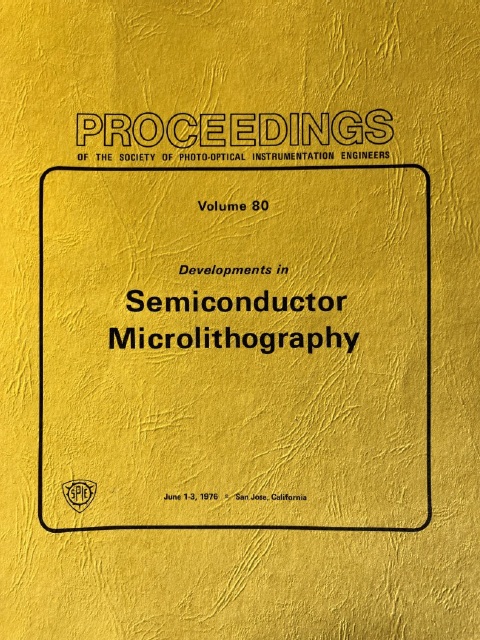
Fifty years is a long time, even for an old guy like me.  That is how long it’s been since the first SPIE lithography conference.  That 1976 conference was held in San Jose and had 26 papers on most of the expected topics:  masks, metrology, exposure tools, resist processing, and even X-Ray lithography.  Three papers were in a special session on making chips for the Viking Mars Lander.  According to the introduction to the conference proceedings (SPIE Volume 80) by conference chair James Giffin, “The meeting was both timely and useful, since semiconductor microlithography is recognized by many in the electronics industry as being the most important process used in the manufacture of complex semiconductor devices.”  It is striking to me that this description would have been applicable to every SPIE lithography conference since, including the one happening in San Jose this week.  So is his last sentence in that introduction: “Ample opportunity was provided to discuss the subject matter with fellow professionals in the field and to explore newly emerging ideas during the panel discussions.”

The Advanced Lithography and Patterning Symposium has grown significantly in those fifty years, as has the entire semiconductor industry, but the core value of the now six conferences that make up the meeting remains the same.  One slight difference is that this year’s panel discussions will be looking backwards rather than forward, in honor of this fiftieth anniversary.  I’ll be on that panel on Monday night (thanks mostly to my advanced age – I’ve been to every SPIE lithography conference since my first in 1985) hoping to glean the important lessons from the past and how they might apply to the future.

And the future is what this symposium is all about – the future of lithography, and as a consequence semiconductor manufacturing, the electronics industry, AI, and just about every other thing about modern life that makes it, well, modern.  Working in lithography all these years has been many things for me: exciting, energetic, educational, stressful, fast-paced, financially rewarding, sometimes frustrating, but never boring.  Mostly I am grateful to be in a community that has given me a welcoming professional home and many lifelong friends.  It is good to be back in San Jose!

Cover of SPIE Vol. 80
Cover of SPIE Vol. 80, 1976